Best LangChain Alternatives for AI Agents in 2026
AI Takeaway
- Best overall alternative for complex agent workflows: LangGraph, especially if you need clearer state, branching, retries, and production control.
- Best alternatives for RAG and knowledge apps: LlamaIndex and Haystack, because they focus on retrieval, document pipelines, search, and knowledge-grounded answers.
- Best options for multi-agent workflows: CrewAI is simpler to start with; AutoGen is useful for agent-to-agent experiments.
- Best option if you do not want to maintain the stack yourself: Look at hosted AI agents or agent runtimes, not just another framework.
Start With the Real Choice: Framework, Builder, or Runtime?
Most LangChain alternatives do not replace the same part of the stack. A tool that is perfect for a RAG app may be the wrong choice for a multi-agent workflow or a hosted assistant.
If you are building an AI feature inside an app, you probably need a framework. You care about prompts, model calls, retrieval, tools, memory, tests, and backend logic. LangGraph, LlamaIndex, Haystack, PydanticAI, Semantic Kernel, Mastra, and the OpenAI Agents SDK live in this world.
If you want to connect apps and build workflows faster, a visual builder may fit better. Dify, Flowise, Langflow, n8n, Zapier, and Make are less about writing orchestration code and more about assembling useful flows with fewer moving parts.
If your goal is an AI agent that keeps working after setup, you need a runtime: somewhere the agent can run, hold context, use tools, connect to channels, trigger scheduled work, log what happened, and recover when things fail. SDK comparisons matter, but the painful part often starts after the first demo works. The distinction is similar to the gap between a model and an agent: one answers, the other carries work forward. This breakdown of AI agent vs. LLM is useful background before choosing a framework.
The Best LangChain Alternatives by Use Case
There is no single LangChain alternative that wins every category. The practical answer depends on the job.
LangGraph for Stateful Agent Workflows
 LangGraph is the most natural move if you like parts of LangChain but want more explicit control. It is built around stateful workflows, graphs, nodes, edges, retries, and human-in-the-loop patterns. That makes it useful for agents that need to branch, pause, resume, or keep durable state.
The tradeoff is complexity. LangGraph is powerful because it asks you to model the workflow clearly. That can feel heavy for a simple chatbot, a small RAG app, or a one-off automation.
Choose LangGraph if you need durable state, branching workflows, auditability, human review steps, and production control over agent behavior.
LlamaIndex and Haystack for RAG Apps
 If the core job is answering questions from documents, LangChain may be more general than you need. LlamaIndex is often cleaner for retrieval-heavy apps because it focuses on connectors, indexes, query engines, and knowledge workflows.
Haystack is another strong option for search, question answering, and enterprise document pipelines. It fits projects that are closer to information retrieval than open-ended agent behavior.
Choose these tools when the main problem is indexing documents, building a knowledge assistant, retrieving source-backed answers, or improving search before adding agent behavior.
CrewAI and AutoGen for Multi-Agent Experiments
 CrewAI is appealing because it gives agents roles, goals, tasks, and collaboration patterns that are easy to understand. It works well for research flows, content workflows, sales assistants, and internal automations with several specialized agents.
AutoGen is still useful for multi-agent conversations and coordination, especially when you want agents to talk through a problem, critique each other, or collaborate with tools.
The important question is whether multi-agent workflows make the system easier to control, debug, and maintain. In many production use cases, one well-designed agent with the right tools beats five agents passing messages around.
{{myclaw_blog_cta}}
PydanticAI, Semantic Kernel, and Mastra for Specific Teams
PydanticAI fits Python developers who want structured outputs, validation, and less framework magic. Semantic Kernel makes more sense for teams already deep in Microsoft infrastructure. Mastra and the Vercel AI SDK are worth considering if your team is TypeScript-first, especially when the AI layer lives inside a Next.js or full-stack JavaScript product. For a broader scan beyond LangChain-style libraries, see this comparison of open source AI agents.
No-Code and Low-Code Alternatives to LangChain
Not every project needs a developer framework. Sometimes the fastest path is a builder that connects models, prompts, data, and tools visually.
Dify, Flowise, and Langflow
Dify, Flowise, and Langflow are useful when you want to assemble chatbots, RAG flows, internal assistants, and model-powered workflows quickly.
They are strongest when the workflow is clear. They become less comfortable when the logic gets custom, permissions get sensitive, or the agent needs deeper control over external tools.
n8n, Zapier, and Make
 n8n, Zapier, and Make are not direct LangChain replacements, but they solve an adjacent problem: getting work to happen across apps. If the goal is "watch this spreadsheet, summarize new rows, notify Slack, create a ticket," a workflow tool may be enough.
The ceiling appears when the work becomes more open-ended. A fixed workflow can trigger steps. An agent needs to decide what to do, inspect changing context, recover from messy inputs, and sometimes ask for confirmation before taking action.
If your agent needs email, calendar, web search, and browser access, integrations become a long-term operating surface, not a one-time setup. If you are comparing this path with Zapier, Make, n8n, or Power Automate, the guide to no code automation tools gives a more workflow-focused view.
What Most LangChain Alternative Lists Miss
The first demo is rarely the hard part. The hard part is making it useful tomorrow, next week, and after a model call fails halfway through a task.
A Working Demo Is Not a Reliable Agent
A notebook demo can call a tool, retrieve a document, or complete a task once. A reliable agent needs persistent sessions, logs, retries, cost visibility, safe tool permissions, scheduled execution, memory management, and a way to inspect what happened.
This is where a framework comparison stops being enough. A framework can help you define the agent. It does not automatically give you hosting, monitoring, updates, auth, channels, or a clean way to manage capabilities. Security matters here too, because agents with tools can touch files, apps, credentials, and production systems. The newer piece on zero-trust agent architecture is a good companion to this part of the decision.
Tool Use Is Only One Layer
Tool calling is important, but it is only one layer. A serious setup also needs a way to add and manage capabilities over time: browser use, Gmail, calendar, code review, web research, and more.
OpenClaw treats skills more like an assistant's app layer. Instead of rebuilding every capability inside one app, you give the agent a controlled set of abilities it can use when needed.
A Simple Decision Matrix
Use this table as a quick way to narrow the options:
| Need | Best Fit |
|---|---|
| Complex stateful agent workflows | LangGraph |
| RAG and knowledge apps | LlamaIndex, Haystack |
| Role-based multi-agent prototypes | CrewAI |
| Multi-agent experiments | AutoGen |
| Typed Python agent apps | PydanticAI |
| Microsoft-centered enterprise apps | Semantic Kernel |
| TypeScript AI apps | Mastra, Vercel AI SDK |
| Visual LLM workflows | Dify, Flowise, Langflow |
| Business app automation | n8n, Zapier, Make |
| Always-on personal or team agents | OpenClaw, hosted agent runtimes |
The simplest rule is to pick the smallest tool that solves the real job. If you only need retrieval, do not adopt a multi-agent framework. If you need a durable workflow, do not rely on a loose chain of prompts. If you need an assistant that works every day, do not ignore hosting and operations.
If You Want an Agent That Runs, Not Another Framework
At some point, the question changes from "Which framework should I use?" to "How do I get an agent that is actually online?"
This is where OpenClaw becomes relevant. It is closer to an AI agent runtime than a traditional SDK: an assistant that can use tools, connect to services, operate through channels, run scheduled work, and keep context over time.
When OpenClaw Makes More Sense
OpenClaw is a better fit when the goal is not to embed an AI feature into a product, but to give an AI assistant work to do: monitor information, run recurring tasks, use a browser, manage files, work through chat channels, combine skills, and keep going without a local laptop staying awake.
This is a different category from LangChain. LangChain helps developers build LLM applications. OpenClaw gives an agent a place to operate.
Managed Hosting Removes the Server Work
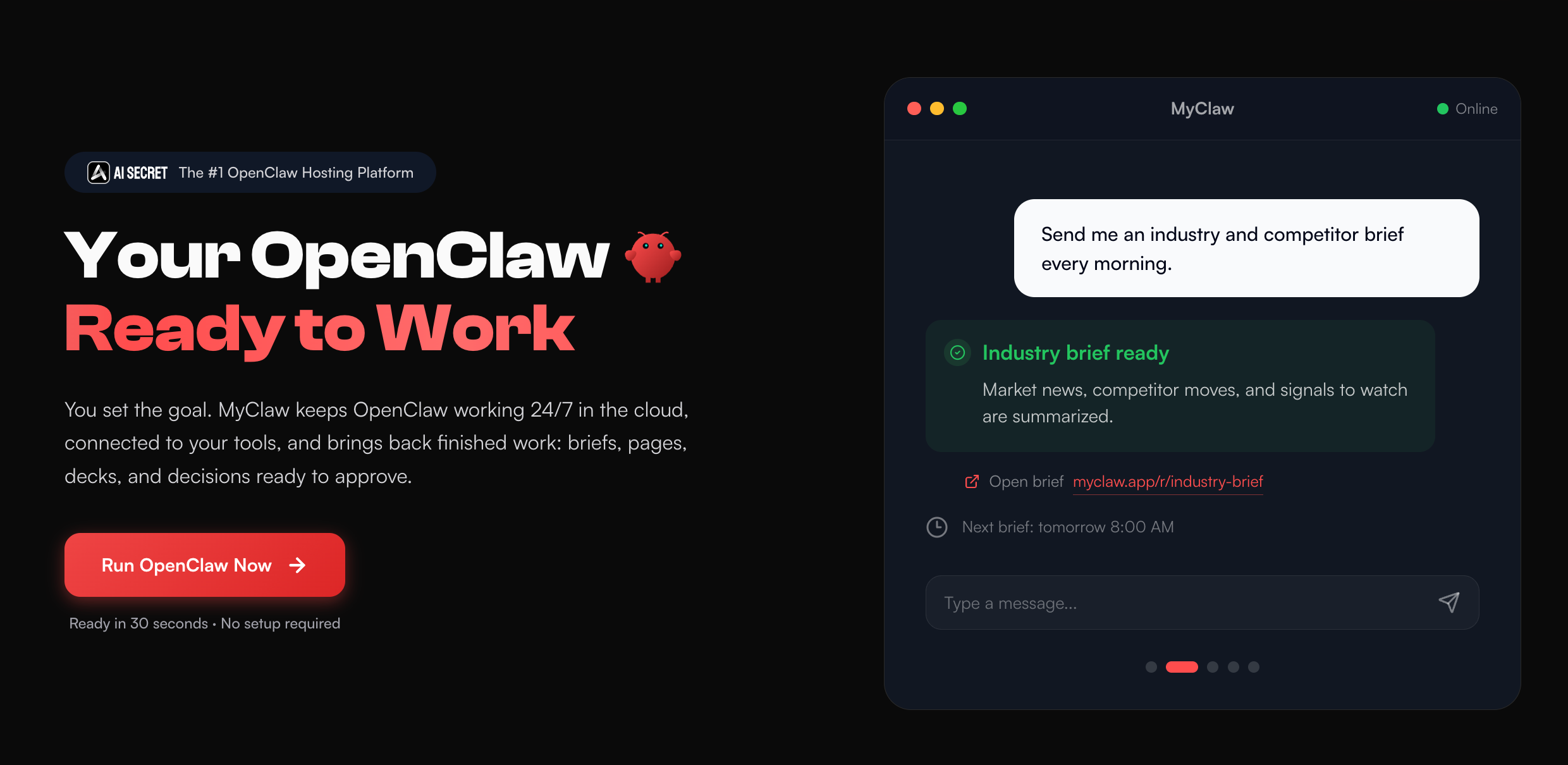 Running that kind of agent still takes infrastructure: a machine, updates, isolation, model configuration, logs, backups, uptime, and a dashboard. MyClaw handles that layer by hosting a private OpenClaw instance, so the agent can stay online without asking you to maintain the server yourself.
That matters most when the assistant is supposed to be used daily. Scheduled work is a good example: an agent that wakes up, checks something, and acts only when needed is much more useful in a stable environment. The SEO AI agent guide shows the same pattern in a concrete workflow: repeated checks, source review, and follow-through instead of one-off answers.
How to Pick the Right LangChain Alternative
Start by naming the real bottleneck. If the problem is orchestration, look at LangGraph or PydanticAI. If it is document search, look at LlamaIndex or Haystack. If it is a visual internal workflow, try Dify, Flowise, n8n, or Zapier. If the agent only works while you babysit the environment, look at runtimes and hosted agents.
Then check production requirements early: where state lives, how failed runs are debugged, whether humans can approve risky actions, how credentials are scoped, whether the agent can run on a schedule, and who maintains the server.
The best LangChain alternative is not always the most powerful framework. It is the one that removes the friction between your idea and a working system.
Conclusion
The best LangChain alternatives fall into different categories. LangGraph is strong for stateful workflows. LlamaIndex and Haystack are better for RAG. CrewAI and AutoGen are useful for multi-agent work. PydanticAI, Semantic Kernel, and Mastra fit specific developer stacks. Dify, Flowise, n8n, Zapier, and Make help when speed matters more than custom code.
But the deeper question is what you want the agent to become. If you are building an AI feature, choose a framework. If you are building a knowledge app, choose a retrieval stack. If you want an assistant that keeps running, uses tools, connects to services, and works without constant maintenance, an agent runtime may be the better path.
That is the gap many framework comparisons miss: building the agent is only half the work. Running it well is the other half.
Skip the setup. Get OpenClaw running now.
MyClaw gives you a fully managed OpenClaw (Clawdbot) instance — always online, zero DevOps. Plans from $19/mo.